
15.3. Burn image
If you need to write a DICOMDIR file to a disk (memory card), enable the corresponding option in the Dick Creator settings dialog (see Section 16.7.7).
15.3.1 Writing the image to an optical Disk
 | Attention! In macOS you can burn a disk image created in the Work Folder to a disk, using the operating system tools (see Section 15.3.3). |
| | On Linux, to burn a disk image on an optical disk, you need to install the wodim command-line utility. Without this utility, a disk image cannot be burned on an optical disk. |
| | On Linux, the DICOM Viewer can detect a device for burning optical disks only if it is unmounted. Mounted devices are ignored. |
To write information to a disk:
-
Click the Burn created DICOM CD/DVD image to the optical disk
 button
on the Disk Creator toolbar. The window shown in Fig. 15.4 will pop up.
button
on the Disk Creator toolbar. The window shown in Fig. 15.4 will pop up.
-
If necessary, select the recorder device from the dropdown menu.
-
Edit the disk name if necessary.
-
If necessary, check/uncheck the Set minimal write speed box (see Section 15.3.4).
-
If necessary, check/uncheck the Automatically clean up the DICOM CD/DVD image after burning disk box.
-
Click OK to write or CANCEL to cancel.
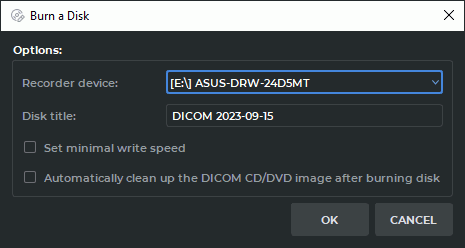
If the Automatically clean up the DICOM CD/DVD image after burning disk box is checked, the information stored in the Work Folder of the creator will be deleted. Otherwise you will be able to record it again.
15.3.2 Write to Memory Card or Folder
To write information to a memory card (flash card) or folder:
-
Click the Write created DICOM CD/DVD image to the flash card or folder
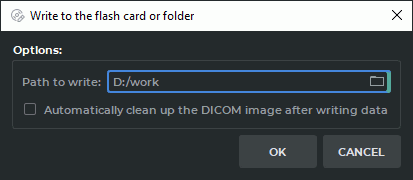
 button on the Disk Creator toolbar. Dialog box is shown in Figure 15.5.
-
Select a memory card or folder on your hard disk. To do this, enter the path in the Path to write field or click the
 button and select the path in the dialog that
opens.
button and select the path in the dialog that
opens.
-
If necessary, check/uncheck the box Automatically clean up the DICOM CD/DVD image after writing data.
-
Click OK to write or CANCEL to cancel.
15.3.3 Burn an image to CD / DVD in macOS operating system
To write information to a disk:
-
The Work Folder should be created, i.e. the folder to store the disk image to be written.
-
Save the information to the created directory, in accordance with the Section 15.3.2.
-
Burn a disk image created in the Work Folder to a CD/DVD using the operating system tools or special applications.
15.3.4 Possible Writing Errors and Remedies
Some parameters of DICOM files may not comply with the requirements of the standard. This may lead to errors when creating a DICOMDIR file. If an error occurs, a notification pops up:
-
Error creating DICOMDIR. Click IGNORE to write the image files to an optical disk or a memory card without a DICOMDIR file or ABORT to cancel the operation;
-
Some files from the work folder weren‘t added to DICOMDIR. In this case, click IGNORE to write the image files to an optical disk or a memory card with a DICOMDIR file, but the data on certain DICOM files will be absent from the DICOMDIR file. Click ABORT to cancel the operation.
| | If there is no need to write DICOMDIR or its correct creation is impossible due to the reasons mentioned above, disable the corresponding option in the disk editor settings (section 16.7.7). |
To minimize the likelihood of errors when writing data to optical disks (CDs/DVDs), set the lowest possible writing speed. It reduces the risk of defects caused by unstable drive work or by poor quality of the disk. The disks recorded at a lower speed are easier to read, especially for older and less powerful drives.
Data burning may fail for some models of CD/DVD-ROMs. To increase the reliability of recording enable image buffering (see Section 16.7.7). In this case, the buffer file for writing is created entirely in the temporary folder of the current user just before writing to disk. Buffer files are created before each recording and are deleted from the hard disk only when the DICOM Viewer is closed. Hence, the amount of free space on the hard disk should be taken into account when writing to the disk multiple times within one session of the program.